PRESS RELEASE
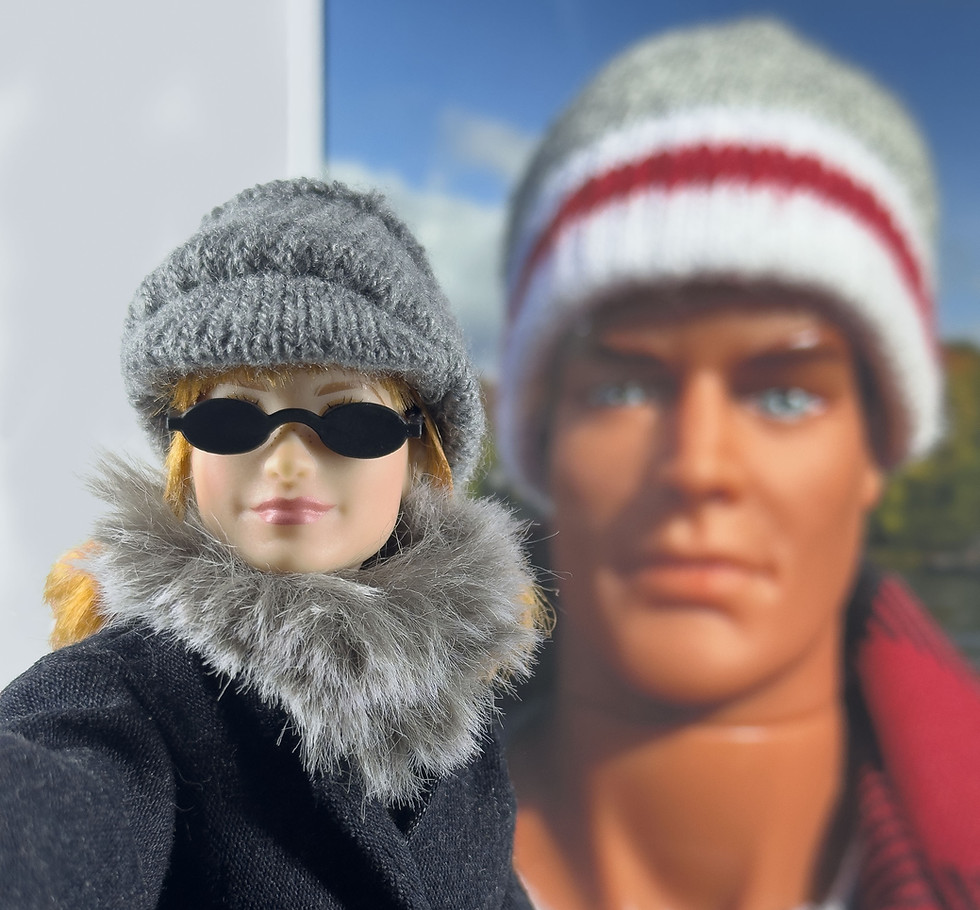
Karey Shinn’s photographic representation of a selfie taken by a 12-inch version of herself, in front of her portrait “Muskoka Joe.”
Portraits: Icons of Thrift
Designer and artist, Karey Shinn photographs dolls, with a sense of awe, style and wit.
Worth Gallery, 830 Dundas Street West, Toronto.
Opening May 28, till June 7.
This hits on so many levels, not least the strangely awesome effect of larger-than-life images of (fairly) realistic dolls modelling in high-concept art photography. With plenty of Canadian content.
Karey Shinn designs and tailors clothes for 12-inch rescue-dolls, then outfits them for poses in photographs that make people smile, “…and I like that,” she says.
There are implicit overtones of the more obvious social issues—the majority of her doll subjects are male action figures, for instance, not “Barbies”—but Shinn’s main focus is elsewhere, addressing the diminished role of handwork in childhood. In other words, playing with older dolls that can be dressed up and down, fingers acquiring dexterity, children gain a tactile sense of agency and material quality—it’s quite different from playing with modern dolls that have stamped-on clothing, or the prevailing activity of typing, tapping, pinching and swiping.
On a personal level, the characters in her photographs are realizations of the lost dolls of her own youth, now rescued from the ignominy of plastic bags in thrift stores, given new identities full of dignity and fresh meaning. And that’s important, to exist in a durable world where things aren’t rushed to the garbage dump, and last for many years.
But the most remarkable thing about Shinn’s photographs is not something she set out to do, but instead an astounding effect she discovered along the way, and developed to a high degree. It has three components:
• A large image
• 12-inch figures (Action Man, Barbie, etc.)
• Wide-angle lens, close to subject
These doll photographs, necessarily taken, because the subjects are small, with a wide-angle lens, create a surprisingly magical illusion of human reality, which is likely caused by their concurrence with the mode of visual intelligence that’s become normalized by the wide-angle lenses in mobile devices, notable for their shallow depth of field that renders backgrounds out-of-focus—an effect long stigmatizing toy photography. But now that this is what we’re familiar with in real life, sharing in social media, it lends an uncanny air of humanity to actual doll photographs. Especially when they’re big, large as life, as it were, occupying much of the viewer’s field of vision.
To cap it all, being the artist that she is, as well as costume designer and environmentalist, many of Shinn’s photographs address the nature of this effect of today’s tech media in a reflexive manner. Exemplary is “Selfie with Joe,” in which she pictures a 12-inch version of herself, as a selfie of herself in front of her enormous head-and-shoulders portrait of “Muskoka Joe,” blurred in the background. Worlds within worlds, icons of thrift.
About Karey Shinn
Karey Shinn (née Asselstine) was born in Winnipeg in 1952 and has pursued parallel careers in art, costume and fashion design, and environmental activism.
She has chaired and participated in numerous Toronto-based environmental committees, organizations and environmental assessment steering committees, most notably in 1992-95 when she initiated Toronto’s first Water Efficiency Plan, recovering built infrastructure capacity worth $250 million by preventing unnecessary expansion of the landmark Harris Filtration Plant in the Beach neighbourhood. As founding Co-Chair of the Public Committee for Safe Sewage Treatment in Metropolitan Toronto, she participated in the Full Environmental Assessment of the Ashridges Bay Sewage Plant from 1991 to 2011, working alongside Julia Langer of the World Wildlife Fund, Metro Toronto Works Committee engineers and the Department of Health to put in place a stringent Sewer Use By-Law that removed over 80% of the mercury, other heavy metals and gender altering chemicals, from entering the water supply in Lake Ontario.
Her costume designs have graced many a Canadian and American show in film, TV and theatre, and her environmentally-themed fashion shows Too Hot Too Wet Too Dangerous (2009), In Bitu: Evening on the Athabasca (2010) and Cosmetic Green (2012) astonished audiences at F.A.T.—Toronto Alternative Art and Fashion Week—as performance art choreographed for the runway and modelled by professional dancers to original electronic music.
Shinn received a BA in Fine Art (Leeds, Yorksire, 1976), and an MFA from Ruskin University in East Anglia, England, 2005. Her art has been exhibited in Europe, Canada and the US. She began work on Portraits: Icons of Thrift during the pandemic, using the world of 12-inch dolls as a focus that synergizes the main themes of her life: making art, making clothes, and caring for the environment.